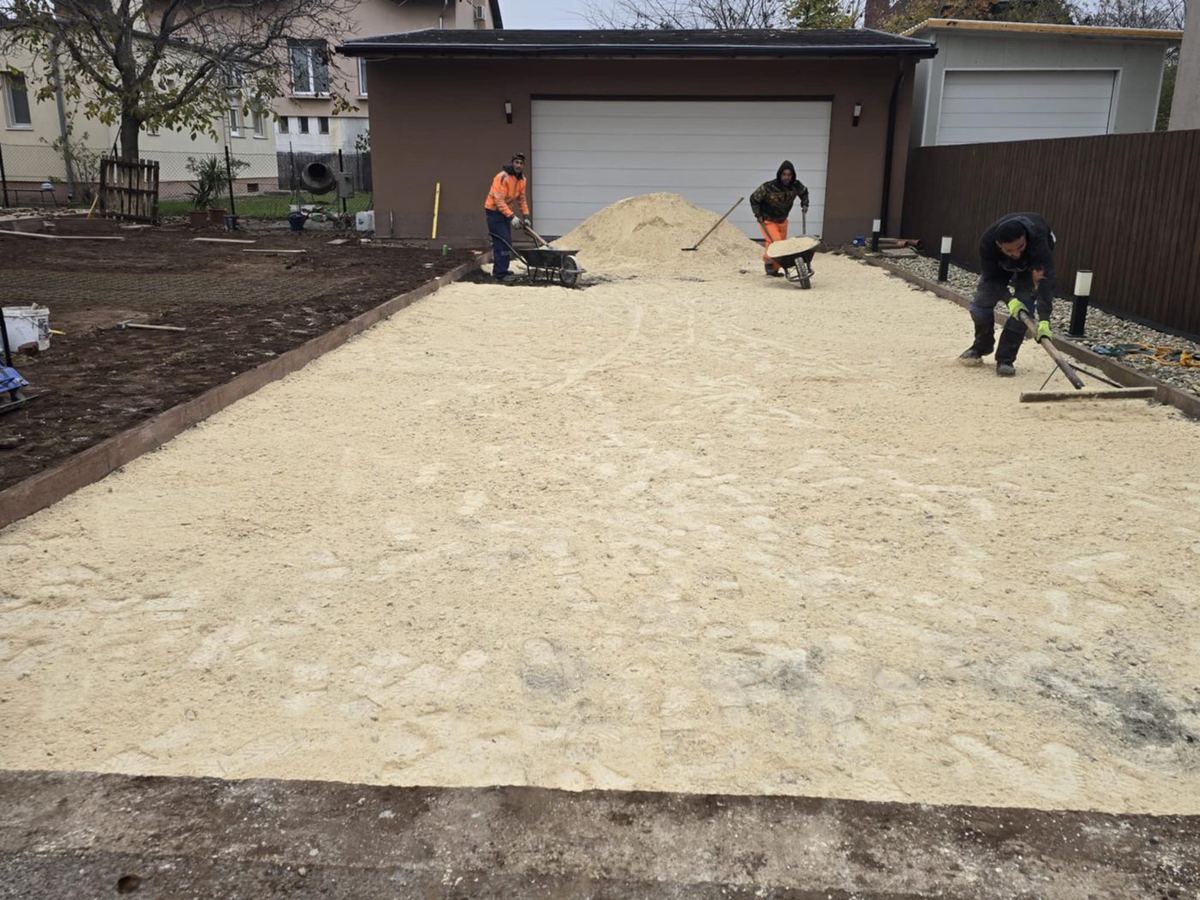
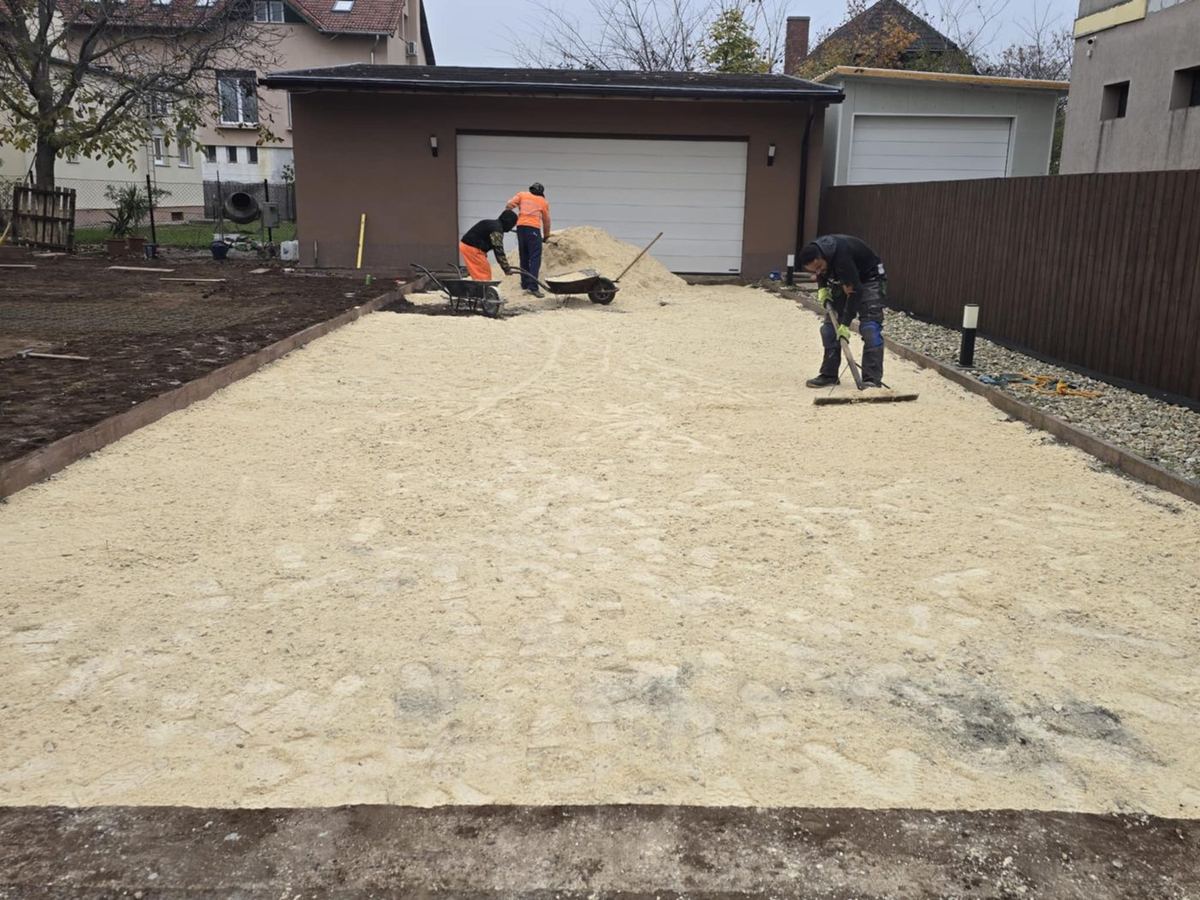
What does a sunken paving repair actually involve?
A proper repair means taking the pavers up, fixing whatever failed underneath and putting the same blocks back to the correct level. Topping up joints with sand or pouring mortar into the hollow only hides the symptom; the softened or washed-out layer below is still there and the dip usually comes back after the next wet season or a few months of car traffic.
Block paving is a flexible pavement. Each block is held in place by its neighbours, by the jointing sand between them and by a firm edge restraint, and the whole surface rests on a thin bedding layer of grit over a compacted granular sub-base. When one of those layers loses support, the blocks above follow it downwards. That is why we treat sinking as a base problem first and a surface problem second.
- Mark the affected area and photograph it before anything is moved.
- Lift the pavers by hand, starting from a cut edge or the lowest point, and stack them in laying order.
- Remove the contaminated bedding and open up the sub-base to see what failed.
- Correct the cause: add and compact granular material, deal with water, trench backfill or roots.
- Lay and screed fresh bedding to the right level and fall.
- Relay the blocks in the original pattern, cutting replacements only where blocks are broken.
- Brush in jointing sand and compact the surface with a plate compactor, then top up the joints.
Our guide repair step by step walks through each of these stages in more detail, including what you should see on site at each point if you are checking the work from abroad through photos. If you prefer to keep an eye on things yourself, those stages are also where it is worth asking for a picture.
Why does block paving sink in the first place?
Paving sinks because something beneath it has moved, compressed or been washed away. In most cases the cause sits in one of a small number of places: a sub-base that was too thin or never properly compacted, water getting under the blocks, a service trench or manhole that settled, tree roots pushing up one side, or vehicle loads the original build was not designed for.
- Insufficient or poorly compacted sub-base, often visible as wide, shallow dishing across a driveway.
- Water from downpipes, gutters or a soakaway carrying fine material out of the base, leaving voids.
- Settlement over backfilled trenches for water, drainage, electricity or telecoms lines.
- A ring of sunken blocks around a manhole or inspection chamber.
- Roots lifting or cracking blocks near trees and large shrubs, with dips forming where roots later die back.
- Vehicle wheel tracks pressing ruts into a surface built for foot traffic.
Each of these needs a different correction, which is why we never quote a blanket fix before looking. The background is covered in why paving sinks, and the specific mistakes made when the base is first built are explained in base failures that cause sinking.
Which paving problems do we repair?
We work on any segmental paving that has lost its level or its grip: concrete blocks, natural stone setts, clay pavers and mixed-size layouts. The common thread is that the surface itself is usually reusable; it is the support underneath, the joints or the water management that has failed.
- Lift and relay – taking up a sunken or uneven section, rebuilding the base and relaying the original blocks.
- Re-levelling uneven paving – correcting dips, humps and trip edges across a patio or path.
- Loose and rocking pavers – restoring interlock where joints have emptied and blocks move underfoot.
- Sinking driveways – wheel ruts, dipping entrances and settlement where cars turn and park.
- Tree root damage – blocks pushed up or cracked by roots near trees and hedges.
- Drainage and standing water – puddles, wrong falls, channel drains at garage doors and thresholds.
- Subsidence diagnosis – working out the real cause before any repair is priced.
If the paving is sound but simply looks tired, stained or faded, it does not need lifting at all. Our sister site renuevatupavimento.eu handles cleaning and recolouring existing pavers without replacing them. A quick look at photos is usually enough to tell which of the two kinds of job your surface needs.
Repair only the sunken area or relay the whole surface?
A localised repair is usually enough when the problem is confined to a clear zone, such as a manhole ring, a trench line or a wheel track, and the rest of the paving sits firm and level. Relaying everything only makes sense when the sub-base is weak across the whole area or the blocks themselves are broken, crumbling or no longer available.
| Situation | Usual approach |
|---|---|
| One or two dips with firm paving around them | Local lift and relay with base correction |
| Ring of sunken blocks around a cover | Lift around the chamber, rebuild support, relay |
| Ruts along the whole driveway where cars run | Larger relay along the wheel paths, sometimes the full width |
| Dishing everywhere, blocks cracked or spalled | Full lifting and new paving (handled by our sister site) |
| Sound surface, only stained or faded | Cleaning and renovation, no lifting needed |
We explain the reasoning behind each choice in repair or replace. When a full replacement is the honest answer, we say so and point you to paving replacement on adoquinadomalaga.eu, which is run by the same self-employed contractor, so you are not passed between strangers.
How do we work with owners who live abroad?
If you own a villa or apartment on the Costa del Sol and spend part of the year elsewhere, the repair process is designed so that you do not need to be standing on the driveway for it to go well; everything can be agreed in English, by email or WhatsApp, with photos at each stage.
- You send photos of the sunken area, ideally one wide shot and one close-up with a spirit level or straight edge laid across the dip.
- We ask a few questions: when it started, whether cars drive over it, where the downpipes discharge, whether any trenches were dug.
- We visit to measure and check access, with you, a neighbour, your property manager or key holder.
- You receive a written quote describing the scope, what is included and what is not.
- During the work you get photos of the opened base, the corrected layers and the finished surface.
This photo trail matters. Once paving is back down, nobody can see what was done underneath, so pictures of the open excavation are the only real record of whether the base was actually corrected. We recommend asking any contractor for them.
Why do puddles form on block paving, and can they be fixed?
Puddles on block paving almost always mean either that part of the surface has settled below its neighbours or that the falls were wrong from the start, so water has nowhere to go. Both can be corrected, but they need different work: settlement is fixed in the base, while poor falls may need re-grading and a drainage channel.
Standing water is not just a nuisance. Water sitting in a hollow soaks through the joints into the bedding, carries fines away and makes the dip deeper each time it rains, so a small depression left alone tends to grow rather than stabilise. Water running towards a house wall or garage threshold is a separate concern, and we treat it as a priority.
The service page on drainage and standing water covers falls, channel drains and gullies. For driveways where the slope itself is the issue, our sister site has a guide on falls and drains on driveways. Both explain why the outlet for the water has to be settled before any channel is fitted.
What affects the cost of repairing sunken paving?
The cost of a repair depends far more on what is found under the blocks than on the size of the dip. Two hollows that look identical from above can need very different amounts of excavation, material and time once the base is opened, which is why we prefer to see photos and visit before putting figures in writing.
- Area to be lifted and relaid, and whether it is one zone or several.
- Depth and condition of the sub-base once exposed.
- Access for a wheelbarrow, materials and a plate compactor.
- Whether the original pavers can be reused or matching blocks must be sourced.
- Drainage work such as a channel drain, gully or redirected downpipe.
- Removal of excavated soil and old bedding as construction waste.
We do not publish prices on this site. Indicative rates for repair work are on our sister site paving repair cost, and you can get a rough band with the paving cost calculator before contacting us. The article what makes a paving repair more expensive explains the factors in plain terms.
Do you need a permit to repair paving in Málaga province?
Repairing private paving is normally minor work, but the exact procedure is set by each town hall, so it is worth checking before work starts. In Andalusia, Law 7/2021 (LISTA), article 138.1.a), places minor works of limited constructive scope that do not need a project under a responsible declaration (declaración responsable), and each municipal ordinance decides which procedure applies to a given job.
For Marbella, Estepona, Fuengirola, Benalmádena, Torremolinos, Mijas and the other towns, the current ordinance of each municipality sets the procedure for a particular paving repair, and its town hall can confirm it. If the job reaches the public pavement or a kerb drop for a vehicle crossing, separate municipal authorisation is generally needed for that part. We are a contractor that carries out the work; we do not draft projects or process licences on your behalf, but we can describe the scope in writing so your gestor or administrator can file it.
In a community of owners, the Horizontal Property Law (Ley 49/1960) applies to common areas such as shared driveways and paths: work needs a resolution of the owners' meeting under article 17, and your community administrator can confirm the exact majority for a given repair. More background is in our sister site's guide to permits and rules for paving.
What happens to the excavated material?
Old bedding, contaminated sand and any soil removed during a repair are construction waste and must be handled as such. Construction and demolition waste is governed by Royal Decree 105/2008 and Law 7/2022, and Law 7/2022 treats rubble from minor domestic building and repair works as household waste under municipal responsibility.
In practice this means the quote should say clearly whether removal of spoil is included, and how it will be taken away. Typical European List of Waste codes when lifting paving include 17 01 01 for concrete, 17 01 07 for mixed concrete, brick and ceramic rubble without hazardous substances, and 17 05 04 for soil and stones. Wherever possible we reuse the original blocks, which keeps the volume of waste small.
How can you keep repaired paving level afterwards?
Repaired paving stays level when its joints stay full, water is kept off the base and the surface is used for the loads it was built for. Most of the follow-up is simple and can be done by a gardener or property manager between visits.
- Check the joints after the first heavy rain and top up with dry jointing sand where they have dropped.
- Keep downpipes discharging into a gully or channel rather than straight onto the paving.
- Avoid pressure washing directly into the joints, which strips the sand that locks the blocks.
- Watch the edges: a loose kerb or edging lets blocks creep outwards and open gaps.
- Report any new dip early, while it is still a small local repair.
Our aftercare guide goes into jointing sand, weeds and cleaning in more detail, and the article when a local repair is enough helps you judge whether a new dip needs attention straight away. Small, early repairs are almost always simpler than waiting until several dips have joined up.
Who is behind Adoquines Hundidos?
Adoquines Hundidos is one of six websites run by the same self-employed paving contractor, Bauman Raymond Attila, based in Marbella and working throughout the province of Málaga. Each site focuses on one kind of problem so that the information stays specific; this one deals only with paving that has sunk, moved or holds water.
If your enquiry turns out to belong elsewhere, for example a brand new driveway, a pool surround or a pure renovation, it stays with the same person; the sister sites simply explain those jobs in more depth. We work with Mapei products where a renovation coating is involved, and for repairs we follow the normal good practice of rebuilding the layers, not covering them up. Send us a photo and the approximate m² – free, no-obligation quote.